
Last reviewed: 23 September 2026
Pre-approval from the Emirates Research and Development Council is mandatory for every R&D Project on which the UAE R&D Tax Credit is claimed. The platform built to receive and evaluate those applications now has a name: Tawwer. This article sets out what has been published about it, what Cabinet Decision No. 215 of 2025 (CD 215/2025) and Ministerial Decision No. 24 of 2026 (MD 24/2026) already fix, and what the Council has still to decide.
Status as at 23 September 2026. The platform has been described publicly by the firm that built it for the Council. RDvault has not identified a public portal address, application form, or published Council rules on pre-approval procedure under CD 215/2025 Article 12(2). This article will be updated when that position changes.
At a glance
- Tawwer is the platform the Emirates Research and Development Council (ERDC) commissioned to centralise the submission, evaluation, tracking and approval of R&D pre-approval applications.
- Its builder describes an AI pre-screen for eligibility, followed by human reviewers, with final decisions taken by R&D experts.
- Its legal basis is MD 24/2026 Article 4(1): pre-approval is obtained “in the form, manner and within the timeline specified by the Council.”
- The test an application must pass is statutory. All five criteria in MD 24/2026 Article 3(1) must be met.
- In a Tax Group, the Parent Company applies (MD 24/2026 Article 13(9)). In a Domestic Group within the Top-up Tax, the Domestic Designated Filing Entity applies (MD 24/2026 Article 14(8)).
- Processing timelines, evidence standards, approval validity and the grievance route have not been published.
What has been published
The fullest public description comes from the platform’s builder, in a case study published on LinkedIn. It explains the problem the Council asked it to solve: applications were growing in number, a manual review process was becoming harder to manage at scale, outcomes varied between reviewers, applicants wanted clearer visibility of where their application stood, and the Council’s leadership wanted a centralised audit trail.
The workflow described runs in six stages. The applicant submits online. AI pre-screens for eligibility. Reviewers are assigned. The application is evaluated against defined standards. It passes through an approval workflow. The applicant is notified.
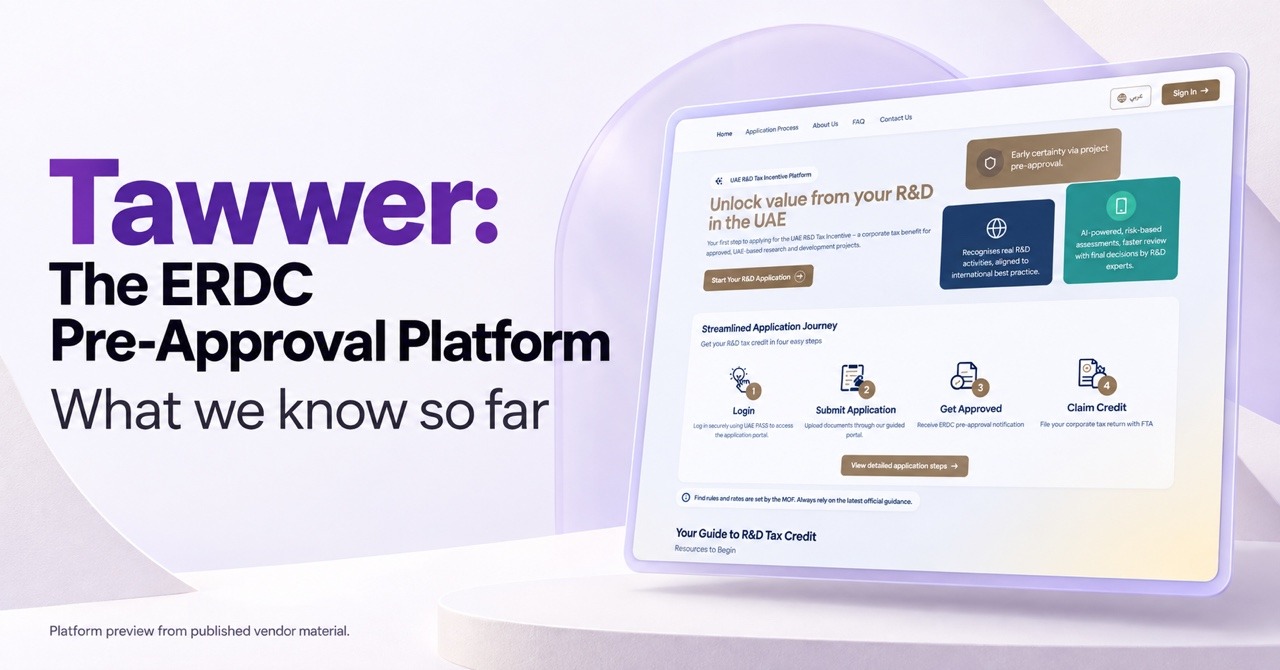
A screenshot of the applicant-facing site in the same material shows a four-step journey: log in using UAE PASS, submit through a guided portal, receive an ERDC pre-approval notification, then file the Corporate Tax return with the Federal Tax Authority. It describes “AI-powered, risk-based assessments” with “final decisions by R&D experts”, and carries a notice that final rules and rates are set by the Ministry of Finance.
Two cautions apply. This is vendor material, so the production portal may differ from any screenshot, and nothing here should be read as a description of the fields applicants will see. And the platform is not the rulebook: the builder’s own material defers to the Ministry of Finance, and the statute defers procedure to the Council.
The legal basis for the portal
Three provisions do the work.
The condition. CD 215/2025 Article 3(1)(b) makes it a condition of claiming that the entity “obtains the necessary pre-approvals from the Council and complies with ongoing compliance requirements”. MD 24/2026 Article 4(1) implements this: a Qualifying Entity “shall obtain pre-approval from the Council for any R&D Project for which the R&D Tax Credit is claimed in the form, manner and within the timeline specified by the Council.”
The proof. CD 215/2025 Article 9(1)(a) requires the claim to be accompanied by proof of obtaining pre-approval. This is why the journey described by the builder ends at the Federal Tax Authority rather than at the Council. The Council approves the project; the Authority assesses the claim. No pre-approval, no claim.
The deadline. The claim is made in the Tax Return for the period in which the qualifying expenditure was incurred, and claims submitted after that return’s due date are not considered unless the Authority accepts them in exceptional circumstances (CD 215/2025 Article 9(2) and (3)). Pre-approval must therefore be in hand by that filing deadline.
What the legislation does not fix is the start point. It does not say whether approval must be obtained before the expenditure is incurred, or whether a project already under way can be approved. Those are matters for the Council, which sets the form, manner and timeline (MD 24/2026 Article 4(1); CD 215/2025 Article 12(2)). Our position is that expenditure incurred before approval should be treated as at risk, and that the prudent baseline is to assume a strict ex-ante sequence, not least because the credit is clawed back where an entity did not continuously meet the qualifying conditions (CD 215/2025 Article 8(1)).
Who submits the application
A standalone Qualifying Entity applies for itself. For groups, MD 24/2026 allocates the obligation:
- Tax Groups. The Parent Company is responsible for applying for pre-approval, submitting the claim as part of the Tax Return, and complying with the related obligations (Article 13(9)).
- Domestic Groups within the Top-up Tax. Where a Qualifying Entity is not subject to Corporate Tax and belongs to a Domestic Group that has appointed a Domestic Designated Filing Entity, that entity applies and claims through the Top-up Tax return (Article 14(8)).
The R&D is often performed in one subsidiary while the filing obligation sits with the parent or the designated filing entity. The people who understand the technical work are frequently not the people who carry the responsibility to apply.
UAE PASS adds a practical question. It is an individual digital identity. If the portal uses it for access, a group will need to decide in advance which authorised individual submits, who signs off the technical content, and how that sign-off is evidenced. The Council has not said how corporate access will work, but groups can settle their own internal answer now.
What a structured review means for how you write
The builder describes AI-driven evaluation supporting consistent scoring. We have no insight into how any model on the platform scores applications, and no adviser credibly does. What is knowable is the standard the application is tested against, because the legislation sets it out.
Under MD 24/2026 Article 3(1), an activity conducted in the State qualifies only where it is novel, creative, uncertain, systematic, and transferable or reproducible. Criterion (e) is a disjunction: site-bound process work that is reproducible but not strictly transferable can still satisfy it. The assessment is made “having regard to” the OECD Frascati Manual (Article 3(2)), which guides the reading of the five criteria rather than replacing them.
Location determines who and what counts. Only activity conducted in the State qualifies (Article 3(3)), and staff costs count only where the R&D Staff are located in the State when performing the activities and are under the supervision, direction and direct control of the Qualifying Entity (Article 8(2)). A distributed team is counted by where its members work. Activity in the social sciences, humanities and the arts is excluded (Article 3(4)), and qualifying expenditure must be at least AED 500,000 for each R&D Project in the tax period, before the staff cost uplift (CD 215/2025 Article 5(3)(b)).
The practical consequence is that structured review rewards structured applications, whoever or whatever reads them first. Take each criterion in turn and state in specific technical terms how the project meets it, separate UAE-conducted work from work elsewhere, draw project boundaries deliberately because the minimum is a per-project test, and use the language of the legislation. A narrative that reads like a product roadmap will struggle against any structured assessment.
The approved record becomes the benchmark
The audit trail the Council wanted serves the Council, but it also fixes the reference point for everything that follows.
The Council may require an R&D Project progress update with technical documentation, as evidence that the activities undertaken are consistent with what was approved at pre-approval (MD 24/2026 Article 4(2)). Technical documentation must be kept for seven years and provided on request, including records of objectives, processes, methodologies, experiments and findings (Article 12(1) and (2)). And where an entity did not continuously meet the conditions for a project, credit already used must be repaid and any unused balance is forfeited (CD 215/2025 Article 8(1) and (2)).
R&D rarely runs to plan. How the Council will treat a project that departs materially from its approved scope has not been published. Until it is, the working assumption should be that the approved application is the document every later update and claim is read against, which makes contemporaneous records more valuable under a centralised system, not less.
What remains open
| Question | What the legislation says | Status |
|---|---|---|
| Must approval precede the expenditure? Can a project already under way be approved? | Timing is for the Council (MD 24/2026 Article 4(1); CD 215/2025 Article 12(2)). The start point is not fixed. | Pending. Treat pre-approval expenditure as at risk. |
| How long does an approval last, and how are multi-year projects handled? | Not addressed. | Pending. See the note below. |
| How long will review take? | Timelines are for the Council (CD 215/2025 Article 12(2)). | Pending. |
| What evidence standard and format will satisfy the Council? | Form and manner are for the Council (MD 24/2026 Article 4(1)). | Pending. |
| What happens if an application is refused? | The Council may set grievance procedures (CD 215/2025 Article 12(2)). | No procedure published. |
A note on approval validity. Several advisers have published that pre-approval is valid for one tax year only, and that an application must be submitted and approved within the year the activities take place, attributing this to Council procedure. Neither statement appears in CD 215/2025 or MD 24/2026, and we have not been able to identify a published Council source for them. Other firms continue to report that the form, manner and timelines are yet to be notified. Treat the one-year position as plausible but unverified, and plan on the basis that a multi-year project may need a fresh application for each period.
What to prepare before the portal opens
None of this depends on the portal being live, and all of it will be needed whatever form the application takes.
- Define each R&D Project: its objective, its technical uncertainty and its boundary, tested against the AED 500,000 minimum.
- Map R&D Staff month by month. The average across the period determines which rate bands are available (MD 24/2026 Article 2).
- Record which work is conducted in the State.
- Draft the technical case against the five criteria, in statutory language.
- Confirm which entity carries the obligation to apply, and who will act for it.
- Put the Article 12 documentation in place from the start of the work, not at year-end.
For the value at stake: the credit is tiered at 15%, 35% and 50%, qualifying expenditure is capped at AED 5,000,000 per tax period, and the maximum credit is AED 2,000,000. In Phase 1 the credit is non-refundable, offsetting Corporate Tax and Top-up Tax liabilities, with unused credit carried forward subject to MD 24/2026 Article 5.
For the full statutory treatment, see our Emirates R&D Council pre-approval guide. For the errors that get applications rejected, see 10 mistakes to avoid.
Frequently asked questions
What is Tawwer?
Tawwer is the platform the Emirates Research and Development Council commissioned to centralise the submission, evaluation, tracking and approval of pre-approval applications for the UAE R&D Tax Credit. The rules governing pre-approval are set by the Council under CD 215/2025 Article 12(2) and had not been published as at the date of this article.
Is Tawwer open for applications?
As at 23 September 2026, RDvault has not identified a public portal address or published Council rules on how to apply. The Council specifies the form, manner and timeline of applications under MD 24/2026 Article 4(1). This answer will be updated when it does.
Does AI decide my pre-approval application?
The platform’s builder describes AI pre-screening followed by human review, with final decisions taken by R&D experts. The statutory decision-maker is the Council (MD 24/2026 Article 4(1)), and the test is the five criteria in Article 3(1), assessed having regard to the Frascati Manual under Article 3(2).
Who applies for pre-approval in a group?
In a Tax Group, the Parent Company (MD 24/2026 Article 13(9)). Where a Qualifying Entity is not subject to Corporate Tax and belongs to a Domestic Group with a Domestic Designated Filing Entity, that entity applies and claims through the Top-up Tax return (Article 14(8)).
Can I claim for R&D that is already under way?
Only with pre-approval, and it must be in hand before you file the Corporate Tax return for the period in which the expenditure was incurred; claims after that deadline are not considered except in exceptional circumstances (CD 215/2025 Articles 9(1)(a), 9(2) and 9(3)). The legislation does not say whether a project already under way can be approved, so expenditure incurred before approval should be treated as at risk.