How the UAE’s Vision 2031 Links to R&D Tax Credits
How the UAE Vision 2031 plan to double GDP connects to R&D tax credits. Explore how national innovation targets are driving private-sector investment incentives.

Shoayb Patel
Founder & CEO

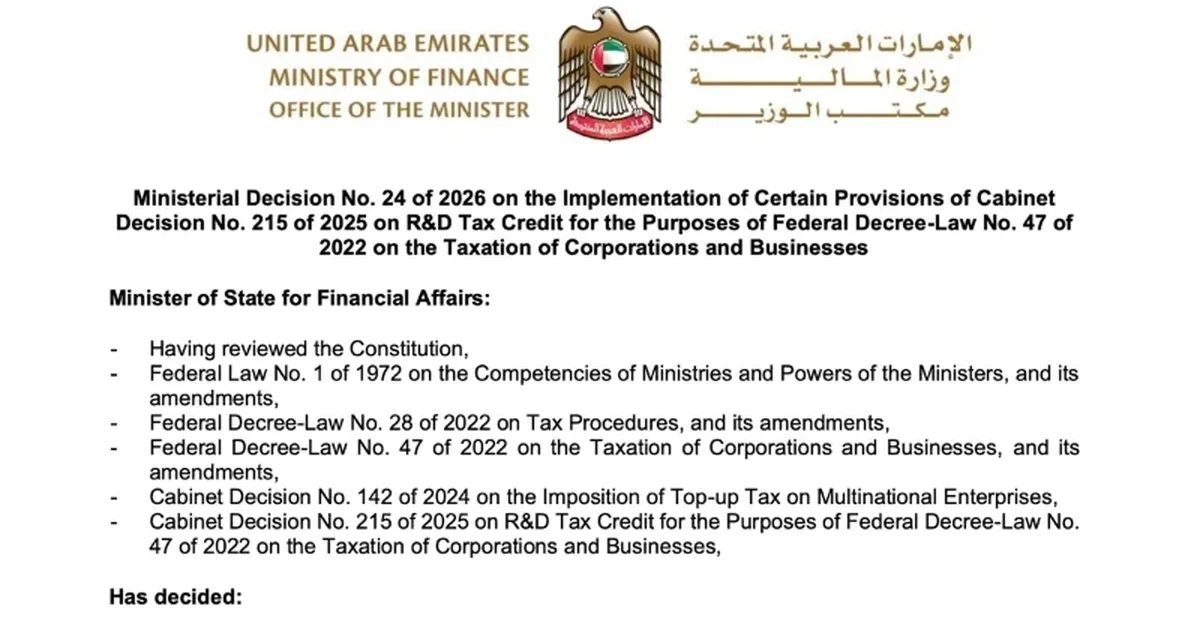
This article has been updated to reflect the confirmed legislation under Ministerial Decision No. 24 of 2026 and Cabinet Decision No. 215 of 2025. See the "Last updated" date above for when changes were made.
What does it take for a nation to double its GDP, triple its non-oil exports, and become a top global hub for innovation, all by 2031? For the United Arab Emirates, the answer is a strategic fusion of policy vision and economic engineering. Through "We the UAE 2031," the government has committed to developing a future-ready society rooted in knowledge, innovation, and sustainable progress. Turning those ambitions into action requires more than inspiration. That's where the UAE's confirmed R&D tax credits come in. Designed to stimulate private-sector investment in high-impact innovation, these incentives aim to create long-term competitive advantage for businesses and fundamental economic transformation for the country.
What Is the "We the UAE 2031" Vision?
Announced in late 2022, the We the UAE 2031 strategy is the UAE's national agenda for the next decade. It aims to double GDP to AED 3 trillion, boost non-oil exports to AED 800 billion, and position the country among the top 10 globally in economic and social development indicators.
Four pillars support the vision: building forward-looking governments, nurturing a thriving economy, fostering social cohesion, and elevating the UAE's global partnerships. Innovation across AI, advanced manufacturing, health sciences, and sustainability sectors underpins all four.
The UAE's Focus on Innovation, Technology, and Economic Diversification
The UAE ranks as the most innovative economy in the Arab world and is placed 32nd in the 2023 Global Innovation Index. However, to remain competitive and close the gap between innovative inputs and measurable outputs, the nation must bolster private-sector R&D participation.
The government has launched strategic investments in space technology, artificial intelligence, and renewable energy. Organic private-sector innovation remains a priority, and R&D tax credits are the lever unlocking the UAE's ambition.
Why R&D Tax Credits Are Critical to Achieving 2031 Goals
In April 2024, the UAE Ministry of Finance announced a digital public consultation to design a new R&D tax incentive scheme, scheduled to take effect for financial years beginning on or after 1 January 2026.
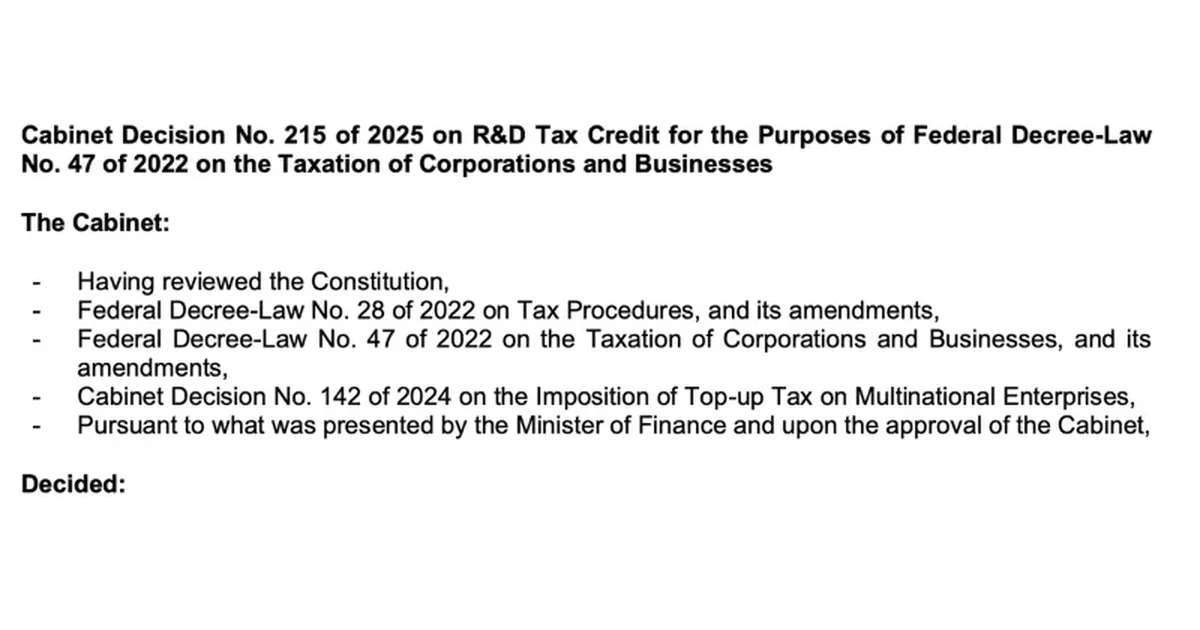
The confirmed legislation under Cabinet Decision No. 215 of 2025 and Ministerial Decision No. 24 of 2026 provides a non-refundable tax credit with tiered rates of 15%, 35%, and 50% on qualifying R&D expenditure. This approach aligns with best practices from OECD member countries and is a first for the UAE's federal tax regime.
Encouraging Private Sector Innovation Through Tax Relief
Until now, innovation in the UAE has often been government-led. Arabian Gulf Business Insight reported that the incentives apply across mainland and free zone jurisdictions, depending on compliance with UAE corporate tax rules. Introducing R&D tax credits is a game-changer for SMEs and foreign-invested companies. It allows startups, scale-ups, and multinationals to offset the cost of riskier, long-term projects, and signals to global investors that the UAE is business-centric and innovation-led.
R&D tax credits create a level playing field by making innovation viable for smaller firms, not just large corporations. They empower early-stage companies to compete in high-tech sectors, bridge funding gaps during development phases, and foster a dynamic startup ecosystem that integrates with global investor expectations.
Vision 2031 Priority Sectors and the Credit Tier They Reach
The R&D tax credit's tiered structure maps directly to the scale and maturity of companies innovating across Vision 2031's priority sectors. Understanding which tier your sector typically reaches helps you plan headcount and R&D investment strategically.
AI and Advanced Technology
AI and software companies conducting qualifying R&D typically enter at Tier 1: a 15% credit on the first AED 1 million of qualifying expenditure, with a minimum of 2 R&D staff. As they scale engineering teams, many reach Tier 2 (35% credit, minimum 6 R&D staff) within two to three years. UAE-based AI companies developing novel models, training pipelines, or autonomous systems, rather than deploying existing tools, are well-positioned to meet the Frascati Manual's technical uncertainty criterion.
Health Sciences and Biomedical Technology
Health tech and biomedical companies conducting clinical research, medical device development, or diagnostic algorithm design often operate at higher headcount levels from the outset. These companies frequently qualify for Tier 2 or Tier 3: the 50% rate applies to qualifying spend between AED 2 million and AED 5 million, with a minimum of 14 R&D staff. The 30% uplift on qualifying staff costs is particularly valuable here, given the salaries of clinical researchers and biomedical engineers.
Sustainability and Clean Energy
Clean energy innovators working on solar technology, water treatment, or carbon capture tend to run capital-intensive R&D programmes spanning multiple cost categories: staff costs, subcontracting fees paid to UAE-based research institutes, and capitalised costs for internally developed IP. This spread across cost categories makes them well-suited to claiming across multiple tiers in a single tax period.
Advanced Manufacturing and Robotics
Advanced manufacturing companies developing new production processes, materials, or robotic systems qualify where the work involves genuine technical uncertainty, for example, solving a materials science problem or developing a novel actuation mechanism. Routine process improvement does not qualify; the technical challenge must be novel to the organisation and systematic in its approach.
The GDP Diversification Mechanism: How the Credit Works at Scale
Vision 2031 targets AED 3 trillion in GDP and AED 800 billion in non-oil exports. R&D tax credits are one of the most effective policy levers for achieving this because they reward delivery rather than intent.
Unlike grants (awarded upfront based on proposals) or subsidies that reduce input costs without regard to outcomes, R&D tax credits reward companies that actually invest in qualifying research and can document it. A company claiming AED 500,000 in R&D credits has, by definition, spent at least AED 1 million on qualifying UAE-based R&D activity. For every dirham the government forgoes in tax revenue, at least two dirhams of private R&D investment have been committed to the UAE economy.
At the maximum credit rate of 50%, a company spending AED 5 million on qualifying R&D receives AED 1.5 million back against its Corporate Tax liability. That company has committed to maintaining at least 14 R&D employees in the UAE: engineers, scientists, and researchers developing IP that remains in the UAE.
What This Means for Businesses Across the Growth Spectrum
The tiered structure reflects a deliberate policy decision to incentivise companies at every stage of growth, from early-stage startups to established multinationals.
For startups (Tier 1): Two R&D employees and AED 500,000 in qualifying spend is the entry point. A software startup with 2 engineers spending AED 700,000 on qualifying development can claim AED 105,000 in credits (15% of AED 700,000). These credits carry forward if the company is loss-making, building a bank of relief to apply when profitability arrives.
For scale-ups (Tier 2): As companies grow their R&D teams to 6 or more and qualifying spend exceeds AED 1 million, the 35% rate unlocks on the incremental spend. A healthtech company with 8 R&D staff and AED 1.8 million in qualifying spend would claim: AED 150,000 (15% on the first AED 1 million) plus AED 280,000 (35% on the remaining AED 800,000), a total credit of AED 430,000.
For established innovators (Tier 3): Companies with 14 or more R&D employees spending between AED 2 million and AED 5 million on qualifying activities access the 50% rate on the top tranche. At this level, the UAE's incentive is among the most competitive internationally.
Linking R&D Credits to Knowledge-Based Industry Growth
R&D tax credits are not open-ended. To qualify, businesses must conduct R&D in science or technology that aims to resolve genuine uncertainty through systematic experimentation, a criterion defined in alignment with the OECD's Frascati Manual.
This means the credits prioritise research in essential growth sectors: AI, robotics, health tech, and clean energy. All of these sectors are earmarked as drivers of Vision 2031.
How These Incentives Support Sustainable, Long-Term Transformation
Unlike subsidies or grants, tax credits offer a sustainable, performance-linked method to reward innovation. They support businesses at the point of delivery, after projects demonstrate credible investment in experimental work.
This model reduces misuse, encourages genuine technological advancement, and builds a future-ready economy where innovation funding becomes integral to doing business, not a one-off win. Over time, R&D tax credits are expected to enhance intellectual property development, increase high-value employment, and attract global R&D centres to the UAE, furthering the national goal of non-oil economic diversification.
R&D tax credits in the UAE promote long-term innovation by encouraging companies to reinvest savings into multi-year projects, boosting investor confidence, and aligning with global tax transparency standards including the OECD's Pillar Two framework. They reduce reliance on one-off grants, support Emirati talent development, and stimulate knowledge-based industry growth.
Government Strategy Meets Business Opportunity
The UAE has proven it can move fast on economic growth and policy. In just over a year, it introduced corporate tax, built a free zone exemption model, and initiated alignment with the OECD's global minimum tax standards.
By embedding R&D tax relief into this structure, the government is giving businesses a meaningful way to contribute to national progress while gaining a measurable return on innovation. This is more than an incentive. It is a handshake between policy and enterprise, saying: help us shape the future, and we'll help you fund it.
RDvault's Role in Supporting the Vision Through Smarter Claims
Tax incentives are powerful but complex. RDvault simplifies this process. The platform helps businesses identify R&D activity, document eligible costs, and submit accurate, compliant filings aligned with the confirmed requirements of Ministerial Decision No. 24 of 2026 and Cabinet Decision No. 215 of 2025.
As UAE-specific guidance continues to develop, RDvault is positioned to help companies align with the Emirates R&D Council's expectations while maximising their claim value. Whether a startup exploring automation or a healthcare firm trialling new diagnostic tools, RDvault reduces administrative overhead while increasing confidence that innovative efforts will be rewarded.
In Conclusion
The UAE's Vision 2031 is both a national aspiration and a blueprint for global leadership. By introducing R&D tax credits aligned with this vision, the government is setting the stage for an innovation era, one where public policy and private enterprise work hand-in-hand.
As businesses invest in qualifying research and platforms like RDvault streamline the process, the UAE's goal of becoming a knowledge-driven economy looks more achievable with every tax period that passes.