Cabinet Decision No. 215 of 2025: What It Means for UAE R&D Tax Credits
Cabinet Decision No. 215 of 2025 establishes the UAE R&D Tax Credit, offering qualifying businesses non-refundable credits of 15–50% on eligible R&D expenditure.

Shoayb Patel
Founder & CEO
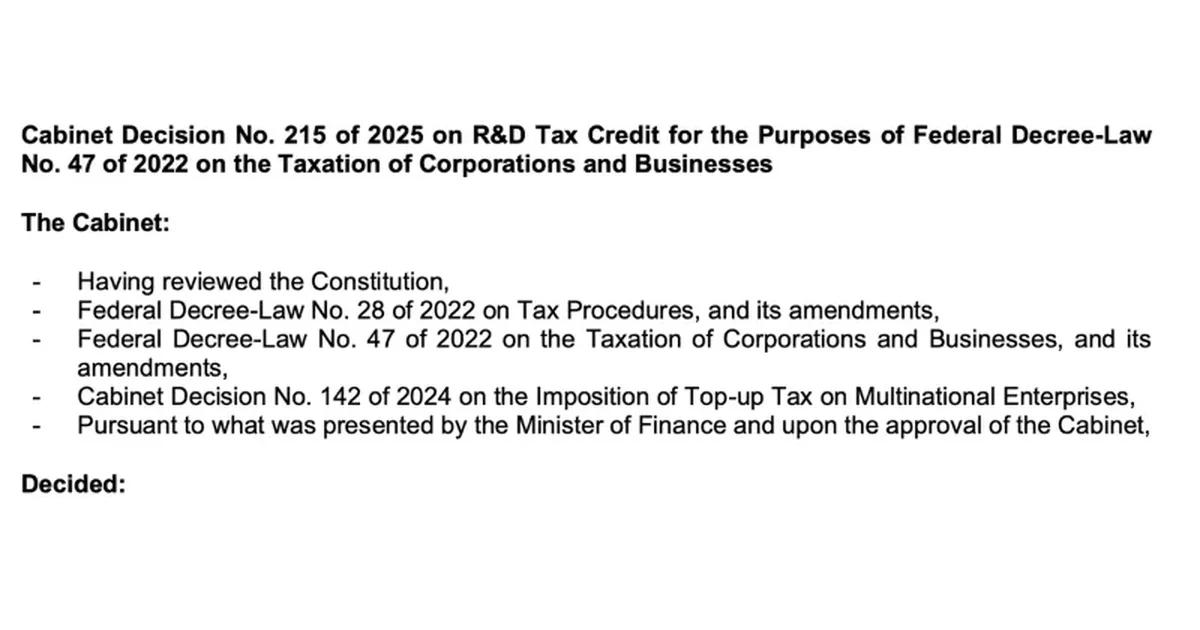
Cabinet Decision No. 215 of 2025 is the legislation that formally establishes the R&D Tax Credit framework for the United Arab Emirates. Issued under Federal Decree-Law No. 47 of 2022 (the UAE Corporate Tax Law), it creates a tiered incentive worth up to AED 2 million per tax period for businesses conducting qualifying research and development in the UAE. If your organisation invests in R&D – whether you are building software, developing new materials, or engineering novel processes – this Cabinet Decision is the legal foundation for claiming a substantial credit against your Corporate Tax liability.
This guide explains every key provision of Cabinet Decision No. 215 of 2025 in plain English, covers the carry-forward and claw-back rules, and sets out what your business needs to do now to take advantage of the scheme.
Background – From Federal Decree-Law No. 47 to Cabinet Decision 215
The UAE R&D Tax Credit did not appear in isolation. It sits within a layered legislative framework that businesses need to understand in order to claim correctly.
In 2022, the UAE introduced Federal Decree-Law No. 47 of 2022, which created the country's Corporate Tax system. From 1 June 2023, businesses earning taxable profits above AED 375,000 pay a 9% Corporate Tax rate. The Decree-Law also authorised the Cabinet to introduce targeted incentives – including an R&D Tax Credit – through secondary legislation.
Cabinet Decision No. 215 of 2025 is that secondary legislation. It establishes the policy framework: who qualifies, what counts as R&D, and the credit rates. But it delegates the operational detail – exactly how to calculate the credit, what documentation to keep, and how to apply for pre-approval – to a further instrument.
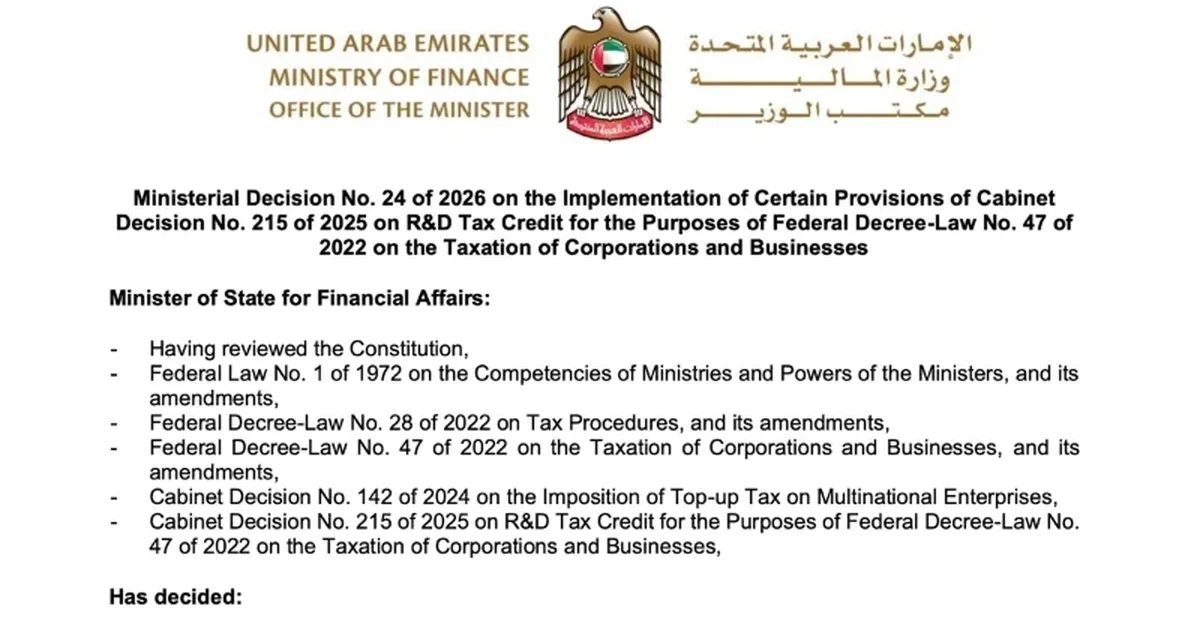
That instrument is Ministerial Decision No. 24 of 2026, which is now in force and covers the implementation rules.
The legislative hierarchy works like this:
Federal Decree-Law No. 47 of 2022 – the overarching Corporate Tax law that authorises the R&D Tax Credit
Cabinet Decision No. 215 of 2025 – the policy decision that establishes the credit framework, eligibility, and rates
Ministerial Decision No. 24 of 2026 – the operational rules: expenditure categories, documentation, credit computation, and pre-approval procedures
Think of it as three layers: the Federal Law grants the power, the Cabinet Decision sets the policy, and the Ministerial Decision provides the implementation manual. You need to understand all three, but this guide focuses on the Cabinet Decision.
What you should do now: Download and read the full text of Cabinet Decision No. 215 of 2025 from the RDvault Legislation Resource Centre. Understanding the policy framework first will make the operational detail in the Ministerial Decision much easier to follow.
Key Provisions of Cabinet Decision No. 215 of 2025
Here are the main components of Cabinet Decision No. 215 of 2025, translated into plain English for business owners and CFOs.
Qualifying Entity
To claim the R&D Tax Credit, your organisation must be a taxable person under the UAE Corporate Tax Law. This includes:
UAE juridical persons (LLCs, PJSCs, private joint-stock companies)
Free Zone Persons subject to Corporate Tax (but not Qualifying Free Zone Persons benefitting from the 0% rate, as they have no CT liability to offset)
Foreign entities with a permanent establishment in the UAE
Entities that elect Small Business Relief for a given tax period cannot claim the R&D credit for that same period. The two incentives are mutually exclusive.
Qualifying R&D Activities
Cabinet Decision No. 215 of 2025 defines qualifying R&D activities using the OECD Frascati Manual as the benchmark. Your activities must satisfy all five criteria:
Novel – new to your organisation or to the field
Creative – involving original thought and design, not routine application of known techniques
Uncertain – the outcome is not predetermined; there is genuine technical or economic uncertainty
Systematic – conducted in a planned, documented manner with a clear methodology
Transferable or reproducible – the results can be documented and communicated to others
Activities that do not qualify include routine testing and quality assurance, market research and consumer surveys, aesthetic or stylistic design (unless it involves technical uncertainty), social sciences and humanities research, and standard software engineering without innovative elements. See our eligibility criteria walkthrough for detailed examples of what passes and fails the Frascati test.
Qualifying R&D Expenditure
The Cabinet Decision identifies five categories of costs that can contribute to the credit:
Staff costs – salaries, wages, and benefits of employees directly involved in R&D, plus costs of qualifying Externally Provided Workers (EPWs). Both attract a 30% uplift (so AED 100,000 in salary qualifies as AED 130,000)
Consumable costs – materials, chemicals, software licences, and supplies consumed in R&D work
Subcontracting fees – payments to third parties for R&D work. The subcontractor must be UAE-based, the work must be performed in the UAE, and no chain subcontracting is allowed. Where the subcontractor is a Related Party, transfer pricing rules under Article 34 of the CT Law apply, and the subcontractor must maintain audited financial statements
Cost Contribution Arrangement (CCA) contributions – arm's length contributions made under Cost Contribution Arrangements for R&D activities, in accordance with UAE transfer pricing rules
Capitalised costs for internally generated intangible assets – where R&D expenditure is capitalised as an intangible asset under UAE tax law rather than expensed
A minimum of AED 500,000 of qualifying expenditure per project per tax period is required, calculated before the 30% staff uplift. The detailed schedules of what counts (and what does not) within each category are set out in Ministerial Decision No. 24 of 2026.
The Tiered Credit Structure
Cabinet Decision No. 215 of 2025 establishes a cumulative three-tier credit system. The credit rate increases as your qualifying expenditure grows, but each tier has its own minimum staffing threshold:
Qualifying R&D Expenditure | Min Avg R&D Staff | Credit Rate | Max Credit from Tier |
|---|---|---|---|
First AED 1,000,000 | 2 | 15% | AED 150,000 |
AED 1,000,001 – AED 2,000,000 | 6 | 35% | AED 350,000 |
AED 2,000,001 – AED 5,000,000 | 14 | 50% | AED 1,500,000 |
Important: the tiers are cumulative, not flat. You do not apply a single rate to your total spend. Instead, the first AED 1 million always attracts 15%, the next AED 1 million attracts 35% (if you have 6+ staff), and any further spend up to AED 5 million attracts 50% (if you have 14+ staff). The maximum credit under Phase 1 is AED 2 million per tax period.
Worked example: A technology company has AED 2.5 million in qualifying R&D expenditure and 16 R&D staff during the 2026 tax year. Their credit is calculated cumulatively:
Tier 1: AED 1,000,000 × 15% = AED 150,000
Tier 2: AED 1,000,000 × 35% = AED 350,000
Tier 3: AED 500,000 × 50% = AED 250,000
Total credit: AED 750,000
If this company has a Corporate Tax liability of AED 1 million, the credit reduces it to AED 250,000.
For a detailed breakdown of how the staffing thresholds work in practice, including how to calculate average headcount, see our staffing thresholds guide (2-6-14).
What you should do now: Map your current R&D expenditure to the five qualifying categories and estimate which tier your business falls into. If you are close to a tier boundary, evaluate whether modest increases in R&D investment or headcount could unlock a higher credit rate.
The Role of the Emirates R&D Council
Cabinet Decision No. 215 of 2025 designates the Emirates R&D Council as the government body responsible for overseeing the R&D Tax Credit scheme (Article 1, Article 3(1)(b), and Article 12(2) of CD 215). The Council has several key responsibilities that directly affect your claim.
Pre-approval authority (CD 215, Article 3(1)(b)): Before you can claim the R&D Tax Credit, you must obtain mandatory pre-approval from the Emirates R&D Council. You cannot simply declare R&D on your Corporate Tax return; the Council must first assess and approve your qualifying activities and projects. Proof of pre-approval must accompany your claim when you file your Tax Return (Article 9(1)(a) of CD 215), meaning pre-approval must be secured before filing. The legislative structure does not contemplate retrospective claims, though the Council has not yet published its prescribed form, manner, or timeline for applications (MD 24, Article 4(1)).
Project oversight (MD 24, Article 4(2)): The Council may, at its discretion, request progress updates at any time during or after the tax period, together with technical documentation as evidence that activities remain consistent with what was approved. This oversight role means you should maintain contemporaneous documentation throughout the life of your R&D projects, not just at year-end when preparing your tax return.
Project-level approval (MD 24, Article 4(1)): Approvals are granted at the R&D Project level, not the entity level. A single company can have multiple approved R&D projects, each contributing to its overall credit pool. If your R&D spans several distinct projects, you will need a separate pre-approval for each. An "R&D Project" is defined in CD 215 Article 1 as a set of Qualifying R&D Activities organised and managed for a specific purpose with its own objectives and expected outcomes.
Tax Group responsibility (MD 24, Article 13(9)): For businesses operating within a Tax Group, the parent company is responsible for applying for pre-approval, submitting the claim for the R&D Tax Credit as part of the Tax Return, and complying with other relevant obligations.
For a step-by-step guide to the pre-approval process, including common rejection reasons and documentation templates, see our Emirates R&D Council Pre-Approval Guide. You can also access the official English text of Cabinet Decision No. 215 of 2025 from the UAE Ministry of Finance website (mof.gov.ae) or from our Legislation Resource Centre.
What you should do now: Appoint one person in your organisation to own the pre-approval process. Begin preparing your project descriptions and supporting documentation now, even if your CT return filing deadline is months away. Early preparation gives you time to address any gaps the Council may identify.
Non-Refundable Credit and Carry-Forward Rules
Cabinet Decision No. 215 of 2025 defines how the credit is applied and what happens when it exceeds your tax liability.
Non-refundable credit: The R&D Tax Credit is non-refundable. It can only be used to offset your Corporate Tax liability (and Top-up Tax where applicable). If the credit exceeds your tax liability, you do not receive a cash payment for the difference. Where you have credits from multiple tax periods, credits must be applied on a FIFO (first-in, first-out) basis — credits arising in earlier tax periods must be used before those from later periods (CD 215, Article 6(2)).
Example: If your R&D credit is AED 750,000 but your Corporate Tax liability is only AED 400,000, you use AED 400,000 immediately. The remaining AED 350,000 is not refunded – it carries forward.
Carry-forward: Unused credits can be carried forward indefinitely and applied against future CT liability. There is no time limit, which is a significant advantage for startups and loss-making businesses that may not have sufficient taxable profit in early years.
The 50% ownership continuity rule: To carry forward unused credits, your business must maintain at least 50% ownership continuity. If more than 50% of your shareholders change during the carry-forward period, all accumulated unused credits are forfeited, subject to two exceptions: (1) where the entity continues the same or similar business activity (Article 39 of the CT Law), and (2) where shares are listed on a Recognised Stock Exchange. Additionally, if R&D activities continue for 2 years during a restructuring (Article 27 CT Law), carry-forward rights are preserved. Credits must be applied on a FIFO basis (earlier periods first). Separately, credits can be transferred to another entity provided both share at least 75% common ownership (MD 24, Article 6(1)); the transferred credit must be used by the recipient in the current period and cannot be carried forward or re-transferred. This is critical for businesses considering capital raises, acquisitions, or investor exits – a VC round that dilutes the original founders below 50% ownership could wipe out your entire credit balance.
Claw-back provisions: Cabinet Decision No. 215 of 2025 gives the Federal Tax Authority power to recover credits in specific circumstances:
Artificial arrangements: If the FTA determines your R&D claim was primarily structured to obtain a tax benefit rather than for genuine innovation, the credit can be clawed back and administrative penalties may apply
Five-year look-back: The FTA has 5 years from the date the credit was claimed to challenge it
Free Zone migration: If your entity relocates from mainland UAE into a Free Zone (or vice versa) within 5 years of claiming the credit, the full credit is clawed back
Non-compliance: Failure to meet documentation, reporting, or pre-approval requirements can result in credit recovery
Five-year status change triggers: If the entity ceases to be a taxable person, becomes a Qualifying Free Zone Person, elects Small Business Relief, enters liquidation, or redomiciles outside the UAE within 5 years of the last claim, all utilised credits are clawed back and unutilised credits forfeited (sourced from MD 24 Article 16(2))
What you should do now: If your business is considering a capital raise, merger, acquisition, or change of shareholders within the next 3–5 years, model the impact on your R&D credit carry-forward. Consult your tax adviser before executing any transaction that could trigger the 50% ownership continuity threshold. If Free Zone migration is on your strategic roadmap, factor in the 5-year claw-back period before making a decision.
What Cabinet Decision 215 Does Not Cover (That Is in the Ministerial Decision)
Cabinet Decision No. 215 of 2025 sets the policy framework, but it deliberately delegates many operational details to Ministerial Decision No. 24 of 2026, which is now in force.
The Ministerial Decision covers:
Detailed expenditure schedules: Granular rules on which costs qualify within each of the five categories (staff, consumables, subcontracting, CCA, capitalised intangible assets)
Documentation requirements: What records you must maintain (project plans, timesheets, invoices, technical reports) and for how long (7 years from the end of the relevant tax period)
Pre-approval application process: The prescribed forms, submission procedures, and timelines for the Emirates R&D Council
Credit computation rules: Step-by-step methodology for calculating the credit across tiers, including average staff count calculations
Tax Group and Domestic Group rules: How groups claim, who is responsible, credit utilisation priority, and the exclusion of all intra-Tax Group transactions (staff cost recharges, consumable supplies, and subcontracting) from qualifying expenditure
Anti-abuse detail: Specific provisions on artificial arrangements and the consequences of non-compliance
If Cabinet Decision No. 215 of 2025 tells you what the scheme is, Ministerial Decision No. 24 of 2026 tells you how to use it. Both are essential reading.
Read our detailed guide to Ministerial Decision No. 24 of 2026 for a plain-English breakdown of the implementation rules. You can also access the full text of all relevant legislation from our Legislation Resource Centre.
What Your Business Should Do Now
Cabinet Decision No. 215 of 2025 is law, and the R&D Tax Credit is available for tax periods starting from 1 January 2026. Here is a practical action plan:
1. Identify your R&D activities. Review your current projects and identify which ones involve genuine novelty, technical uncertainty, and systematic investigation. Many businesses have qualifying R&D without realising it – particularly in software development, engineering, and product design. See our eligibility criteria guide for detailed examples.
2. Start documenting now. Create a centralised repository for all R&D documentation: project plans, timesheets, invoices, technical notes, test results, and decision records. Contemporaneous documentation (created as the work happens) carries far more weight than retrospective records prepared at year-end.
3. Estimate your credit. Map your R&D costs to the five qualifying categories and calculate your potential credit using the tiered rates. This will help you understand the financial value of the scheme and may justify additional investment in R&D or documentation processes.
4. Review your staffing thresholds. Understand which tier your business can credibly achieve (2, 6, or 14 average R&D staff). If you are near a threshold boundary, assess whether modest hiring could unlock a higher credit rate. See our staffing thresholds guide.
5. Prepare for pre-approval. Begin drafting your application to the Emirates R&D Council. This mandatory step must be completed before you file your Corporate Tax return. See our pre-approval guide for step-by-step instructions.
6. Engage specialist advice. The R&D Tax Credit involves technical, legal, and commercial judgement. Working with a specialist adviser who understands both the legislation and the pre-approval process can significantly increase the value of your claim and reduce the risk of rejection or FTA challenge.
7. Understand the full claiming process. Read our step-by-step guide to claiming the UAE R&D Tax Credit, which covers everything from eligibility confirmation and documentation through Emirates R&D Council pre-approval to FTA filing.
For a comprehensive overview of all UAE R&D tax incentives available in 2026, read our pillar article: UAE R&D Tax Incentives 2026: Everything Your Business Needs to Know.
If you have questions about Cabinet Decision No. 215 of 2025 and whether your business qualifies, learn about our process or book a free consultation with one of our specialists.