UAE R&D Tax Staffing Thresholds: The 2/6/14 Rule
The UAE R&D Tax Credit requires minimum staffing of 2, 6, or 14 R&D employees per tier. Miss the headcount and your credit rate drops. Here is how the rule works.

Shoayb Patel
Founder & CEO

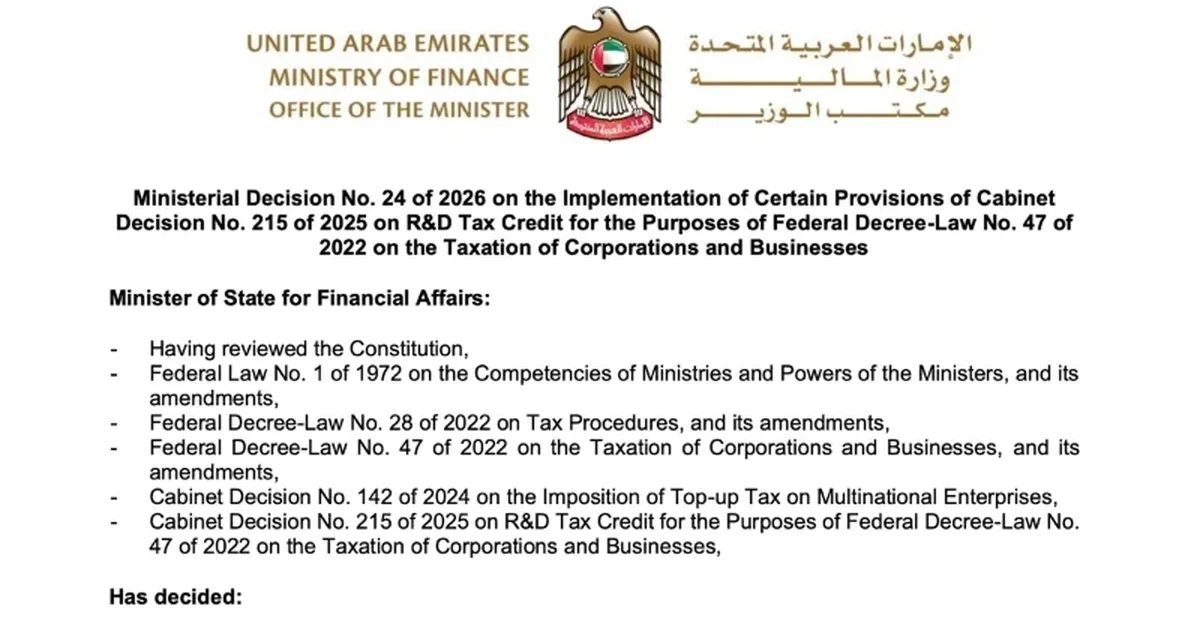
The UAE R&D Tax Credit is not purely a spending-based incentive. Under Ministerial Decision No. 24 of 2026 (MD 24/2026), access to each credit tier depends on meeting two conditions simultaneously: a minimum qualifying expenditure band and a minimum average R&D staff headcount. Miss either condition and the credit rate falls back, automatically, to the highest tier where both are satisfied.
This is the aspect of the regime that trips up the most businesses. A company can spend AED 4 million on qualifying R&D and, if the average staff headcount is below 14, not qualify for the 50% tier. The difference in credit value can be hundreds of thousands of dirhams. The RDvault team has written this guide to clarify exactly how the thresholds work, who counts as R&D staff, and how businesses should plan around the dual condition.
The Three Credit Tiers: Exact Numbers from MD 24/2026
MD 24/2026 sets out a progressive, tiered credit structure. Each tier has both an expenditure band and a minimum R&D staff threshold. Both must be satisfied for a given tier to apply:
Qualifying R&D Expenditure (per Tax Period) | Minimum Avg R&D Staff | Credit Rate | Max Credit on This Tier |
|---|---|---|---|
First AED 1,000,000 | At least 2 | 15% | AED 150,000 |
AED 1,000,001 to AED 2,000,000 | At least 6 | 35% | AED 350,000 |
AED 2,000,001 to AED 5,000,000 | At least 14 | 50% | AED 1,500,000 |
Maximum possible credit: AED 2,000,000. This is AED 150,000 + AED 350,000 + AED 1,500,000 across all three tiers. The AED 5 million figure that appears in government announcements refers to the qualifying expenditure cap, not the credit value. The credit is non-refundable against corporate tax liability.
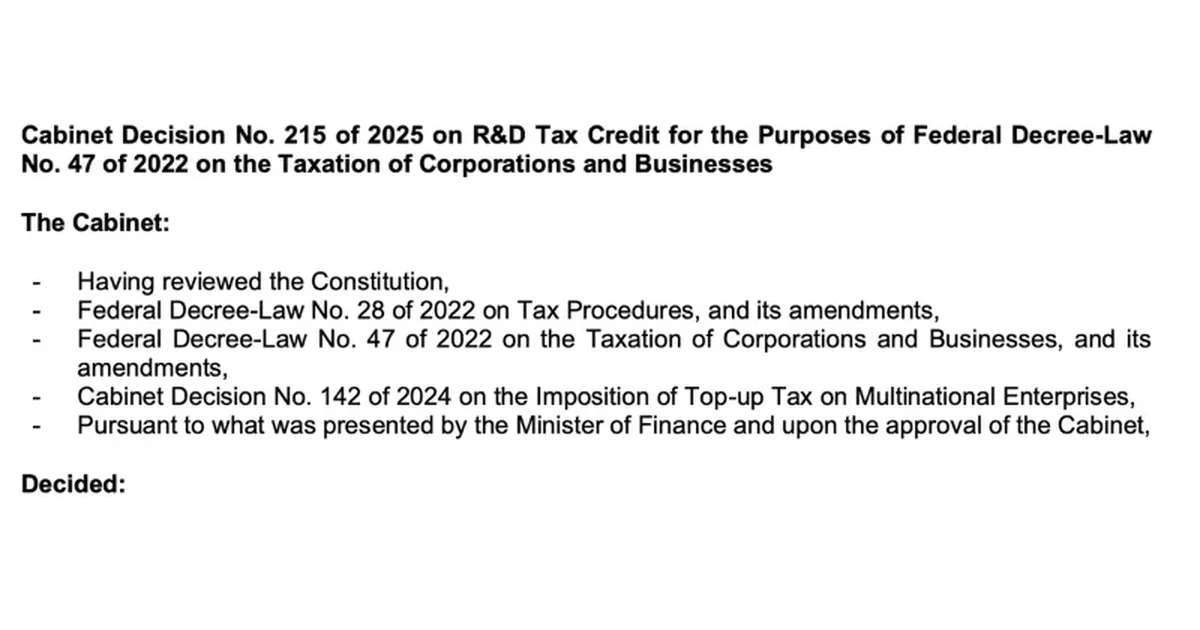
These rates apply to qualifying R&D expenditure as defined under Cabinet Decision No. 215 of 2025 (CD 215/2025) and MD 24/2026. The minimum project spend is AED 500,000 per R&D project per tax period, calculated on base qualifying expenditure before the 30% overhead uplift on staff costs is applied (CD 215/2025 Article 5(3)(b); MD 24/2026 Article 8(3)).
The Dual Condition: Both Must Be Met Simultaneously
MD 24/2026 Article 2.7 is unambiguous. If a Qualifying Entity meets the expenditure threshold for a higher tier but falls short on R&D staff headcount, the credit rate adjusts downward to the highest tier where both conditions are satisfied simultaneously.
There is no partial credit. There is no apportionment. The rate drops in full.
The cliff-edge effect, illustrated:
Entity A spends AED 2.5 million on qualifying R&D. It has an average of 13 R&D staff throughout the year.
AED 2.5M expenditure would normally reach Tier 3 (50%), but 13 staff falls one short of the 14 minimum.
The entity falls back to Tier 2 (35%), which only requires 6 staff.
Credit: AED 150,000 (Tier 1) + AED 350,000 (Tier 2) = AED 500,000
If it had hired one additional qualifying R&D employee, it would receive an additional AED 250,000 on the AED 500K spend above AED 2M at 50%.
A single qualifying hire is worth AED 250,000 in additional credits in this scenario.
This is why headcount planning matters as much as R&D spending in the UAE regime. The cliff-edge effects at 2, 6, and 14 staff mean that the marginal value of each additional R&D employee can be substantial.
Who Qualifies as an R&D Staff Member?
MD 24/2026 Article 1 defines an R&D Staff member as a full-time or full-time equivalent employee, or a full-time or full-time equivalent externally provided worker, who is directly and actively engaged in Qualifying R&D Activities and meets the conditions of Article 8.
Three categories of personnel can qualify, consistent with the Frascati Manual framework which MD 24/2026 explicitly references in Article 3(2):
Researchers, professionals engaged in the conception or creation of new knowledge, products, processes, methods, or systems.
Technicians, personnel who perform scientific and technical tasks under the supervision of researchers.
Direct supporting staff, administrative, clerical, or secretarial staff directly assigned to and supporting R&D projects. General administration does not qualify.
All three categories can contribute to the R&D staff headcount, not just PhD researchers. A company with 14 people including researchers, lab technicians, and dedicated R&D project administrators may qualify for the 50% tier.
Staff must be UAE-based. MD 24/2026 Article 8 requires R&D staff to be in the UAE when performing qualifying R&D activities. Employees based overseas, even if working on UAE R&D projects, do not count toward the headcount threshold.
Do Subcontractors Count Toward Headcount?
Yes. MD 24/2026 Article 2(5) is explicit on this point. For subcontracted Qualifying R&D Activities, the Qualifying Entity calculates its average R&D staff headcount using both the subcontractor's and its own staff who are directly and actively engaged in the qualifying activities.
This is a significant planning point. Entities with a lean internal R&D team can use subcontracted R&D workers to reach a higher staffing tier, provided the subcontractor is UAE-based, the work is done in UAE, and the conditions of MD 24/2026 Article 10 are met. Chain subcontracting is not permitted, the engagement must go directly to the subcontractor.
Intra-Tax Group exclusion: Subcontracting within a Tax Group does not count. MD 24/2026 Articles 8.11, 9.5, and 10.3 exclude all costs between Tax Group members from qualifying expenditure. This applies equally to the headcount position, internal group arrangements cannot be used to manufacture staff numbers.
Externally Provided Workers: A Distinct Category
MD 24/2026 Article 8(9) introduces a category of R&D personnel that is legislatively distinct from both employees and subcontractors: Externally Provided Workers (EPWs). An EPW is an individual who satisfies all four conditions of Article 8(9): (a) is not a director or an employee of the Qualifying Entity; (b) provides their services through a staff provider company or as an independent contractor or service provider; (c) is personally obliged to provide the services under a contract with the Qualifying Entity or the staff provider company; and (d) provides services that do not constitute subcontracting of R&D Activities by the Qualifying Entity.
The distinction matters for two reasons. First, EPW costs are treated as Staff Costs under the regime, not as subcontracting costs. This means they qualify for the 30% overhead uplift on staff costs under Article 8(3), which subcontractor costs do not. Second, EPWs count toward the headcount thresholds in exactly the same way as direct employees. As with all R&D Staff, EPWs must be located in the UAE when performing Qualifying R&D Activities and must be under the supervision, direction and direct control of the Qualifying Entity (Article 8(2)(b)).
The practical examples include agency researchers placed through a staff provider company, independent R&D consultants personally contracted to the entity, and technical personnel engaged through a service provider. The "personally obliged" condition in Article 8(9)(c) is important: the contract must be for a named individual's services, not for a team or a deliverable. A consultancy engagement where the firm assigns whoever is available would not meet this test.
EPW planning example:
Entity B has 4 permanent R&D employees and engages 3 agency scientists through a staff provider company. Each scientist is personally contracted, works on-site in the UAE under Entity B's supervision, direction and direct control, on qualifying R&D projects.
The 3 agency scientists qualify as EPWs under Article 8(9), not subcontractors.
Total qualifying headcount: 4 employees + 3 EPWs = 7 average R&D staff.
Entity B qualifies for Tier 2 (35%) on expenditure between AED 1M and AED 2M, which it would have missed with only 4 staff.
The EPW costs are treated as Staff Costs and qualify for the 30% uplift, increasing qualifying expenditure further.
EPWs are not subcontractors. Article 8(9)(d) draws the line: the individual's services must not constitute subcontracting of R&D Activities. All R&D Staff, including EPWs, must work under the Qualifying Entity's supervision, direction and direct control (Article 8(2)(b)). The "personally obliged" condition (Article 8(9)(c)) adds a further test: the individual must be personally contracted to provide services. Misclassifying EPWs as subcontractors means losing the 30% staff cost uplift. Misclassifying subcontractors as EPWs risks the entire cost being disallowed. The classification must be documented at the point of engagement.
Documentation for EPWs
For EPWs to count toward headcount and qualify for staff cost treatment, the following documentation should be maintained alongside the general records required under Article 12:
The contract with the staff provider company, independent contractor, or service provider, clearly identifying the named individual and their role (Art. 8(9)(c) — "personally obliged" requirement)
Evidence that the EPW works in the UAE and is directly and actively engaged in Qualifying R&D Activities (Art. 8(2)(a))
Evidence that the EPW is under the supervision, direction and direct control of the Qualifying Entity (Art. 8(2)(b))
Time allocation records per EPW per month, per project, on the same basis as direct employees
Evidence distinguishing the engagement from subcontracting under Article 10 (Art. 8(9)(d))
Invoices or payment records from the staff provider company, independent contractor, or service provider
How Average Headcount Is Calculated
MD 24/2026 Article 2(4) sets out the averaging methodology. The average number of R&D staff is calculated as:
Average R&D staff = Total R&D staff for each month during the Tax Period ÷ Total number of months in which Qualifying R&D activities were undertaken
A staff member who worked any part of a calendar month counts as 1 for that month, regardless of whether they worked the full month. This is a monthly headcount average, not a strict full-time equivalent calculation.
Part-Time and Dual-Role Employees
MD 24/2026 Article 8(7) addresses the cost side for part-time R&D workers: only the portion of staff costs reasonably attributable to qualifying R&D activities is included as qualifying expenditure. An engineer spending 60% of their time on qualifying R&D contributes 60% of their salary to qualifying expenditure.
However, for headcount purposes, the monthly averaging methodology counts them as 1 for any month they are engaged in qualifying R&D activities. This creates a genuine tension: the cost contribution is pro-rated, but the headcount contribution under Article 2(4) is binary at the monthly level.
The Frascati Manual, referenced under MD 24/2026 Article 3(2), suggests that individuals spending less than 10% of their working time on R&D should not be included in R&D personnel counts. This is established international guidance, and RDvault's view is that it represents a defensible position when determining who should contribute to the headcount threshold. However, MD 24/2026 does not explicitly state a minimum time-allocation threshold, and the Emirates R&D Council has not yet issued specific guidance on this point.
Tax Groups: Pooling Headcount Across Subsidiaries
MD 24/2026 Article 2(3) states: where a Tax Group includes more than one Qualifying Entity, the Qualifying R&D Expenditure and R&D Staff of all Qualifying Entities shall be aggregated for the purposes of the thresholds in Article 2(1). The operative words are "all Qualifying Entities" — each subsidiary contributing to the pool must itself be a Qualifying Entity conducting qualifying R&D activities. A subsidiary with zero R&D staff and no qualifying R&D expenditure cannot contribute headcount simply by being in the Tax Group.
A holding structure with three UAE subsidiaries, each independently conducting qualifying R&D and each employing five R&D staff, can pool those 15 employees to exceed the 14-person threshold for the 50% tier — provided each subsidiary is itself a Qualifying Entity as defined in CD 215/2025. This aggregation applies to both expenditure and headcount simultaneously.
Where Interpretations Differ
The UAE R&D tax regime is new. The legislation does not resolve every question, and public guidance from the Emirates R&D Council remains limited. RDvault has identified the following areas where reasonable professional disagreement exists:
Minimum Time Allocation for Headcount Eligibility
MD 24/2026 does not specify what proportion of working time an employee must spend on qualifying R&D activities before they count toward the headcount threshold. The monthly averaging methodology implies that any engagement in qualifying R&D during a month makes a person eligible. The Frascati 10% threshold provides international guidance but is not confirmed UAE law. Until the Emirates R&D Council issues specific guidance, this remains an open question requiring a professionally defensible position.
Subcontractor Headcount: Article 2(5) Scope
Article 2(5) confirms that subcontractor staff count toward headcount. What remains unclear is whether this applies only where the Qualifying Entity's own staff are also engaged, or whether a fully subcontracted R&D project with zero internal R&D headcount could satisfy the threshold entirely through subcontractor staff. The spirit of the regime suggests genuine internal R&D commitment is expected.
Tax Group Conditions for Headcount Pooling
MD 24/2026 Article 2(3) provides that qualifying R&D expenditure and R&D staff of all Qualifying Entities within a Tax Group shall be aggregated for the purposes of the thresholds in Article 2(1). The question of whether all Tax Group members must themselves be conducting qualifying R&D to contribute headcount, or whether a member's staff can be counted without that member incurring qualifying expenditure of its own, is not addressed in the text of Article 2(3). Emirates R&D Council guidance on this point has not yet been published.
Shoayb's Consideration Points
There are five questions worth deliberating as RDvault advises clients on the UAE R&D tax regime.
1. The 10% Frascati threshold as a planning floor. I believe the most defensible position for part-time R&D workers is to apply the Frascati 10% FTE threshold as a minimum before including anyone in the headcount count. It's persuasive international guidance. A person spending two days a year on qualifying R&D should not, in my professional view, contribute to a company's staffing threshold. But this needs official confirmation from the Emirates R&D Council.
2. Subcontractor headcount: planning or risk? Article 2(5) opens the door to a strategy where a company with limited internal R&D staff uses UAE-based subcontractors to reach a higher tier. This is legitimate planning, but the substance requirement is real. If a company lacks genuine internal R&D capability and is simply routing work through a subcontractor to manufacture headcount, that will not withstand scrutiny. The documentation and control tests in Articles 8 and 10 set a high bar.
3. Free Zone companies claiming R&D credits. The claw-back rule in MD 24/2026 Article 16(2) is one of the most significant advisory risks encountered in the UAE regime. If a company claims R&D credits and then migrates to Free Zone status within five years, every dirham of credit is clawed back as Payable Tax. For companies in Dubai Silicon Oasis, DIFC, or any other Free Zone considering claiming credits, this must be addressed as a strategic decision, not an afterthought.
4. Documentation requirements for headcount. The regime is substance-driven. Claiming 14 R&D staff without contemporaneous records of what those employees were doing, when, and on which projects will not be defensible on audit. Time-tracking, project-level allocation records, and role descriptions aligned to the Qualifying R&D Activity definition are the minimum standard. RDvault builds this into every client engagement from day one.
5. Timing the staffing threshold. The monthly averaging methodology creates a planning opportunity. If a company expects to exceed AED 2 million in qualifying expenditure in the second half of the year, frontloading R&D activity into periods of higher headcount, or bringing subcontracted R&D workers on in earlier months, could improve the annual average. This requires active coordination between HR, finance, and R&D project management.
Documentation Requirements for Headcount Claims
Under MD 24/2026 Article 12, qualifying entities must maintain records for seven years. For staffing thresholds specifically, the following documentation is required:
Written role descriptions demonstrating direct and active engagement in Qualifying R&D Activities
Time allocation records per employee per month, per project
For subcontracted R&D staff: the subcontractor agreement, evidence of UAE location, and records of their engagement in qualifying activities
For Externally Provided Workers: the staffing agreement or independent contractor agreement, evidence of the entity's right of direction and control, and records distinguishing the engagement from subcontracting
Payroll records including all staff cost components (salaries, allowances, bonuses, medical insurance, gratuity, training)
Evidence that stock option plans are excluded from qualifying staff costs (Article 8.5)
Claims must be submitted with the corporate tax return and must include audited financial statements. Claims submitted late are not accepted unless the FTA agrees in exceptional circumstances.
The Free Zone Claw-Back Risk
MD 24/2026 Article 16(2) contains a provision that is not widely discussed but is one of the most operationally significant in the entire regime. If, within five years of last claiming the R&D tax credit, a Qualifying Entity becomes a Qualifying Free Zone Person, all previously utilised credits are clawed back as Payable Tax. Unutilised credits are forfeited.
For UAE-incorporated companies operating in or near Free Zones, this creates a genuine strategic risk. Any company considering Free Zone migration, restructuring into a QFZP structure, or acquiring a Free Zone entity must take specialist advice before claiming R&D credits. The window is five years from the last claim, not from the first claim.
Pre-approval is mandatory before any claim. Entities must obtain pre-approval from the Emirates R&D Council before claiming the R&D tax credit. As of 7 April 2026, the Council's application portal has not yet been published. RDvault is monitoring the Council's announcements and will update clients as soon as the portal is live.
Frequently Asked Questions
How many R&D employees do I need to claim UAE R&D tax credits?
At least 2 average R&D staff to qualify for the 15% credit on the first AED 1 million of qualifying expenditure. At least 6 for the 35% rate on expenditure between AED 1 million and AED 2 million. At least 14 for the 50% rate on expenditure above AED 2 million. Both the expenditure and staff conditions must be met simultaneously.
What happens if I have the right spend but not enough R&D staff?
The credit rate drops automatically to the highest tier where both conditions are satisfied. If you have AED 3 million of qualifying expenditure and only 5 R&D staff, you qualify only for the Tier 1 rate of 15% on the first AED 1 million. The AED 2 million above that receives no credit.
Can consultants or contractors count towards the R&D staff headcount?
Yes. MD 24/2026 Article 2(5) confirms that for subcontracted R&D, the headcount of both the subcontractor's staff and the Qualifying Entity's own staff engaged in the qualifying activities is combined. The subcontractor must be UAE-based, the work must be done in UAE, and the conditions of Article 10 must be met. Chain subcontracting is not permitted.
How is average R&D headcount calculated?
Average R&D staff = total R&D staff for each month in the tax period, divided by the number of months in which qualifying R&D activities were undertaken. A staff member who worked any part of a calendar month counts as 1 for that month, regardless of whether they worked the full month.
Can a group of companies pool their R&D staff to meet the threshold?
Yes. For Tax Group members, qualifying R&D expenditure and R&D staff are aggregated across the group to determine the applicable credit tier. This means a corporate group can combine the R&D headcount of multiple subsidiaries to reach a higher tier.
If an engineer spends 60% of their time on R&D, do they count as one R&D staff member or 0.6?
For cost purposes, only 60% of their staff costs qualify as R&D expenditure. For headcount purposes, the monthly averaging methodology counts them as 1 in any month they are engaged in qualifying R&D. The Frascati Manual suggests a 10% FTE minimum threshold should apply, but MD 24/2026 does not explicitly state this floor. RDvault's position is that a defensible minimum time allocation should be applied and documented.
What is an Externally Provided Worker (EPW) under the UAE R&D tax regime?
Under MD 24/2026 Article 8(9), an EPW is an individual who satisfies four conditions: (a) is not a director or employee of the Qualifying Entity; (b) provides services through a staff provider company or as an independent contractor or service provider; (c) is personally obliged to provide the services under a contract; and (d) provides services that do not constitute subcontracting. EPWs count toward the headcount thresholds and their costs are treated as Staff Costs with the 30% uplift. As with all R&D Staff, they must be under the supervision, direction and direct control of the Qualifying Entity (Art. 8(2)(b)).
What is the difference between an EPW and a subcontractor for UAE R&D tax purposes?
Article 8(9)(d) draws the line: an EPW's services must not constitute subcontracting of R&D Activities. EPWs must also be personally obliged to provide services under contract (Art. 8(9)(c)) and work under the entity's supervision, direction and direct control (Art. 8(2)(b)). EPW costs are treated as Staff Costs and qualify for the 30% overhead uplift under Article 8(3). Subcontractor costs are a separate expenditure category governed by Article 10. Both count toward headcount, but through different legislative provisions: EPWs via the R&D Staff definition in Article 1, and subcontractors via Article 2(5).
Is the 30% staff cost uplift added before or after the AED 500K minimum spend is calculated?
The AED 500,000 minimum project spend per tax period is calculated on base qualifying expenditure, excluding the 30% overhead uplift on staff costs (CD 215/2025 Article 5(3)(b)). The 30% uplift applies to staff costs only, not to total qualifying expenditure; it is added to the staff cost component under MD 24/2026 Article 8(3) to produce the uplifted staff cost figure, which then forms part of total qualifying expenditure alongside consumables and subcontracting fees.
How RDvault Can Help
The staffing threshold is not an administrative formality. It is a substantive condition that determines which credit tier applies and how much credit is available. Getting it wrong in either direction, claiming too many or too few qualifying staff, creates compliance risk and financial exposure.
RDvault works with UAE businesses from their first year of qualifying R&D activity. The RDvault team helps clients identify which employees qualify, build the documentation framework to support headcount claims, and structure R&D delivery, including subcontracting arrangements, to optimise credit tier eligibility without manufacturing arrangements that lack substance.
For a detailed review of your R&D staffing position before the pre-approval portal opens, contact the RDvault team.
Understand your staffing threshold position now
The pre-approval portal is not yet open. That means there is still time to assess your R&D staff position, align documentation, and plan your headcount before the first claim.