
Last updated: 4/10/2026
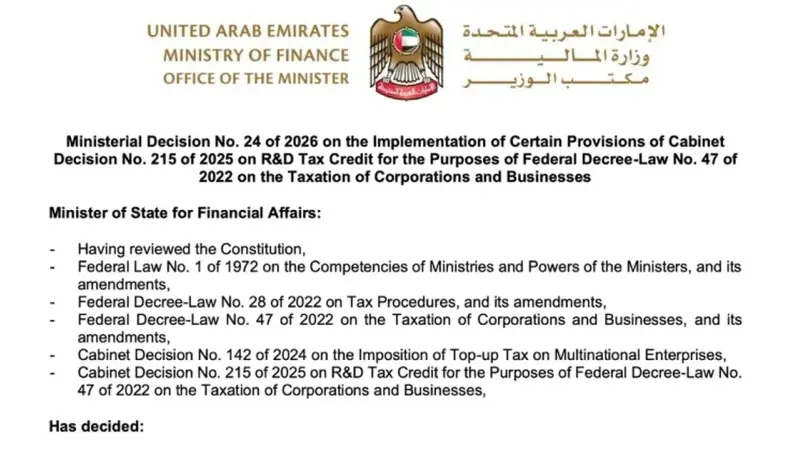
Official sources: Cabinet Decision No. 215 of 2025 and Ministerial Decision No. 24 of 2026.
Ministerial Decision No. 24 of 2026 is the operational manual for the UAE R&D Tax Credit – covering pre-approval, qualifying expenditure, credit computation, and anti-abuse rules.
Ministerial Decision No. 24 of 2026 is the operational manual for the UAE’s R&D Tax Credit scheme. Whilst Cabinet Decision No. 215 of 2025 established what the credit is and who qualifies, Ministerial Decision No. 24 specifies how to claim it. This post covers the implementation rules, compliance requirements, and practical steps your organisation needs to follow to secure the credit from the UAE’s tax authority.
If you are considering applying for the R&D Tax Credit in the UAE, understanding the mechanics outlined in Ministerial Decision No. 24 of 2026 is essential. This decision sets out the pre-approval process, eligible expenditure categories, credit calculation methodology, documentation standards, and anti-abuse provisions that govern how the scheme operates in practice.
Important clarification: The maximum R&D Tax Credit is AED 2,000,000 per tax period, not AED 5,000,000. AED 5,000,000 is the cap on qualifying expenditure. Multiple media reports and some adviser commentary conflate these figures. The distinction matters enormously for business case calculations: 15% on the first AED 1M, 35% on the next AED 1M, and 50% on the remaining AED 3M produces a maximum credit of AED 2,000,000.
How Ministerial Decision 24 Relates to Cabinet Decision 215
The UAE’s R&D Tax Credit operates within a clear legislative hierarchy:
- Federal Decree-Law No. 47 of 2022 – the primary tax legislation
- Cabinet Decision No. 215 of 2025 – established the R&D Tax Credit scheme, eligibility criteria, and credit rates
- Ministerial Decision No. 24 of 2026 – implements the operational rules and compliance framework
Cabinet Decision No. 215 answered the strategic questions: Is your organisation eligible? How much credit can you claim? Ministerial Decision No. 24 answers the procedural questions: How do you apply? What expenditure qualifies? What documentation do you need? How is the credit calculated?
Think of CD 215 as the policy framework and MD 24 as the rulebook. One defines eligibility and rates; the other defines the process and compliance obligations.
What you should do now: Review our detailed analysis of Cabinet Decision 215 to understand the broader policy context and eligibility requirements before diving into the implementation details in this post.
Qualifying R&D Activities: The Five-Criteria Test (Article 3)
MD 24 Article 3 sets out five criteria that an activity must satisfy simultaneously to constitute a Qualifying R&D Activity. Article 3(2) provides that the assessment shall be made having regard to the OECD Frascati Manual (2015); the Manual is an interpretive reference standard, not binding UAE law in its own right. Partial satisfaction is not sufficient all five must be met.
1. Novel (Article 3(1)(a)): The activity must aim to produce new findings. Being new to the business is not sufficient by itself. All five criteria must be met, having regard to the OECD Frascati Manual: novel, creative, uncertain, systematic, and transferable or reproducible.
2. Creative (Article 3(1)(b)) The activity involves original concepts or hypotheses. Routine changes to products or processes that do not involve creative conceptual work are excluded by this criterion. Common failure: standard product updates or routine feature additions.
3. Uncertain (Article 3(1)(c)) The outcome or means of achieving it are not known in advance. Genuine technical uncertainty is required whether about whether the objective can be achieved at all, or about how it can be achieved. Common failure: projects with known solutions where the task is implementation, not discovery.
4. Systematic (Article 3(1)(d)) The activity follows a plan and budget. The project must be organised and managed in a structured way with defined resources. Common failure: informal development work without documented methodology or progress tracking.
5. Transferable/Reproducible (Article 3(1)(e)) The results can be applied or replicated in other contexts. In practice this requires documentation: results that exist only in researchers’ heads cannot be transferred or reproduced. Common failure: know-how that exists solely in engineers’ heads and is not recorded.
The activity must be conducted in the UAE. R&D conducted overseas by employees or contractors, even if the entity is UAE-based, does not qualify. Social sciences, humanities, and arts are explicitly excluded from the definition of Qualifying R&D Activities.
The Pre-Approval Process (Articles 4–5)
One of the most critical features of Ministerial Decision No. 24 of 2026 is the mandatory pre-approval requirement. Before you can claim the R&D Tax Credit in your Corporate Tax return, you must obtain written approval from the Emirates R&D Council.
Council pre-approval is mandatory for each R&D project claimed. Applications must follow the form, manner and timeline specified by the Emirates Research and Development Council, and proof of approval must accompany the tax credit claim. Confirm the Council’s current submission, timing and renewal requirements directly before applying.
The Application Process
To obtain pre-approval, you must:
- Submit an application to the Emirates R&D Council in the prescribed form and manner
- Provide detailed information about your R&D activities, qualifying expenditure, and staffing
- Include all supporting documentation (technical reports, project timelines, cost breakdowns)
- Wait for written approval before filing your Corporate Tax return
The Emirates R&D Council has discretion to request progress updates and additional information during the approval process. You must respond to these requests promptly and comprehensively.
Council Approval and Claim Timing
Council pre-approval is mandatory for each R&D project claimed. Applications must follow the form, manner and timeline specified by the Emirates Research and Development Council, and proof of approval must accompany the tax credit claim. Confirm the Council’s current submission, timing and renewal requirements directly before applying.
Even if your project meets all the substantive criteria in Cabinet Decision 215, the procedural requirement for pre-approval is mandatory and non-negotiable.
What you should do now: Prepare your technical and expenditure records and confirm the Council’s current application requirements. Contact our team to discuss the evidence for your projects.
Qualifying R&D Expenditure Categories (Articles 8–11)
Ministerial Decision No. 24 of 2026 specifies precisely which expenditure categories qualify for the credit and how they are treated. Understanding these categories is essential because not all R&D costs are eligible, and some eligible costs are subject to limitations.
Qualifying Expenditure Categories
Staff Costs (with 30% Uplift)
Salaries and employment costs for employees directly involved in qualifying R&D activities are eligible, together with costs of qualifying Externally Provided Workers (EPWs). Both attract a 30% uplift. However, MD 24 includes a significant uplift: the qualifying amount is 130% of actual staff costs – a 30% allowance over and above actual expenditure to account for overheads (MD 24, Article 8(3)). Where an employee does not work full-time on R&D, only the proportional share of their costs attributable to qualifying R&D activities counts there is no minimum percentage threshold (MD 24, Article 8(7)). EPWs are not employees they are individuals who provide services through a staff provider company or as an independent contractor, are personally obliged under contract, and whose services do not constitute subcontracting (MD 24, Article 8(9)). Both employee and EPW costs attract the same 30% uplift.
This uplift recognises the value generated by R&D staff and incentivises investment in R&D personnel.
Consumable Materials and Supplies
Materials consumed directly in R&D activities qualify, including:
- Laboratory materials and reagents
- Software licences and tools used in development
- Testing and quality assurance materials
- Prototyping consumables
Capital equipment is not directly deductible as a credit item, but contributions under Cost Contribution Arrangements (CCAs) may qualify under specific circumstances (see below).
Subcontracting Fees
If you outsource part of your R&D to external contractors, the subcontracting fees qualify as eligible expenditure provided: the subcontractor is UAE-based, the work is performed in the UAE, no chain subcontracting is allowed, and where the subcontractor is a Related Party, transfer pricing rules under Article 34 of the CT Law apply and the subcontractor must maintain audited financial statements.
Cost Contribution Arrangement (CCA) Contributions
Arm’s length contributions made under Cost Contribution Arrangements for R&D activities qualify as eligible expenditure, in accordance with UAE transfer pricing rules. This typically applies to joint R&D ventures where multiple parties share costs.
Capitalised Costs for Internally Generated Intangible Assets
Where R&D expenditure is capitalised as an intangible asset under UAE tax law rather than expensed, these costs also qualify as eligible expenditure for the R&D Tax Credit.
AED 500,000 Minimum Per Project
Each qualifying R&D project must have a minimum of AED 500,000 in qualifying expenditure per tax period. Importantly, this minimum is calculated excluding the 30% staff cost uplift – it is based on actual expenditure only.
If your actual qualifying expenditure on a given project is below AED 500,000, you cannot claim the credit for that project in that tax period. This threshold applies per project – you cannot aggregate expenditure across multiple smaller projects to reach the minimum. However, if you have several R&D projects that each independently exceed AED 500,000, all of them contribute to your total qualifying expenditure pool.
Excluded Expenditure
The following categories are explicitly excluded from qualifying expenditure:
- General administrative costs (unless directly attributable to R&D)
- Market research and commercial development costs
- Training unrelated to specific R&D projects
- Costs already funded by government grants or subsidies (to avoid double-dipping)
- Land and buildings (except imputed rent for dedicated R&D facilities)
- Financing costs and loan interest
What you should do now: Audit your R&D cost categories and prepare a detailed breakdown of actual expenditure by category (staff, materials, subcontracting, capital). Ensure you have supporting documentation for each category and verify that at least one project exceeds AED 500,000 in actual qualifying expenditure.
The Credit Computation and Tiered Rate Structure (Article 2)
This is the core of the credit calculation. Ministerial Decision No. 24 of 2026 implements a cumulative tiered credit structure, meaning the credit applies at different rates to different portions of your qualifying expenditure, and the rates stack.
The Tiered Rate Structure
The credit rates are based on your average R&D staff count:
- Tier 1: 15% credit on qualifying expenditure up to AED 1 million (minimum 2 average R&D staff)
- Tier 2: 35% credit on qualifying expenditure from AED 1 million to AED 2 million (minimum 6 average R&D staff)
- Tier 3: 50% credit on qualifying expenditure from AED 2 million to AED 5 million (minimum 14 average R&D staff)
Critically, these tiers are cumulative, not flat. If your qualifying expenditure is AED 3 million, you do not receive a flat 50% credit. Instead, you calculate the credit across all three tiers:
- AED 0–1M at 15%
- AED 1M–2M at 35%
- AED 2M–3M at 50%
Average R&D Staff Count Methodology
To qualify for Tier 2 or Tier 3, you must meet the minimum average R&D staff count for the tax period. The average is calculated by adding the total number of R&D Staff for each month, then dividing by the number of months in which Qualifying R&D Activities were undertaken (MD 24, Article 2(4)) not necessarily 12 months if R&D was conducted for only part of the year.
R&D Staff are defined as full-time or full-time equivalent employees and EPWs who are directly and actively engaged in Qualifying R&D Activities (MD 24, Article 1). Part-time R&D contributors count as the corresponding FTE fraction. For subcontracted activities, the staff count includes both the subcontractor’s and the entity’s R&D staff directly engaged in the work (MD 24, Article 2(5)).
You must maintain detailed payroll and time tracking records to substantiate your staff count calculation. The Emirates R&D Council will scrutinise this closely during the approval process.
Worked Example: Cumulative Tier Calculation
An entity with AED 3 million of fully qualifying expenditure and at least 14 average qualifying R&D staff would calculate AED 1 million of credit: AED 150,000 on the first AED 1 million, AED 350,000 on the next AED 1 million and AED 500,000 on the remaining AED 1 million. Entity eligibility, project approval and utilisation conditions still apply.
This illustration assumes the AED 3 million is the final qualifying-expenditure amount after applicable allocation, exclusions and uplift, and that each included project satisfies the AED 500,000 minimum before uplift. The three bands produce AED 150,000 + AED 350,000 + AED 500,000 = AED 1,000,000. It is not a cash refund or a determination that a particular claim will be accepted.
Tax Group and Domestic Group Rules (Articles 13–14)
If your organisation is part of a tax group or domestic group for Corporate Tax purpose, Ministerial Decision No. 24 of 2026 applies special rules to credit claims.
Parent Company Responsibility
In a tax group structure:
- The parent company is responsible for obtaining pre-approval from the Emirates R&D Council for the group’s R&D activities
- The parent company files the credit claim in its own Corporate Tax return
- Individual subsidiaries do not file separate credit claims
This centralised approach simplifies administration and prevents double-claiming across group entities.
Credit Utilisation and Priority Order
When the group has a credit to utilise, it applies in the following order:
- First: Against the parent company’s Corporate Tax liability
- Second: Against the parent company’s Top-up Tax liability (if any)
- Carry-forward: Any unused credit is carried forward indefinitely (subject to the ownership continuity rule – see below). Earlier credits should be applied first.
Credits cannot be distributed to subsidiary companies for offset against their own tax liabilities. The credit is a group-level entitlement.
Pre-Grouping Credits
If a company joins a tax group and has carried-forward R&D Tax Credits from before joining the group, those credits remain available for use by that company, subject to the ownership continuity rule.
Tax Group Credit Transfers
Importantly, all intra-Tax Group transactions – including staff cost recharges, consumable supplies, and subcontracting between group members – are excluded from qualifying expenditure (MD 24, Articles 8(11), 9(5), and 10(3)). Separately, under Article 6 of MD 24, credits can be transferred between entities with at least 75% common ownership; the transferred credit must be used by the recipient in the current period and cannot be carried forward or re-transferred.
What you should do now: If your organisation is part of a tax group, ensure that your parent company manages the pre-approval and credit claim process centrally. If you have historical carried-forward credits, document the transition carefully to preserve carry-forward eligibility. Ensure intra-group transactions are properly documented and excluded from claims.
Documentation and Record-Keeping (Article 12)
The UAE tax authority takes documentation seriously. Ministerial Decision No. 24 of 2026 requires comprehensive technical and financial documentation to support your credit claim.
What Records Must Be Maintained
You must maintain:
- Technical documentation: Detailed project descriptions, technical specifications, development timelines, and evidence that activities meet OECD Frascati Manual criteria (novel, creative, uncertain outcomes, systematic approach)
- Staff records: Payroll records, employment contracts, time tracking or project allocation records showing each person’s percentage of time spent on qualifying R&D activities
- Cost records: Invoices, payment vouchers, payroll journals, and cost allocation schedules for all categories of qualifying expenditure
- Subcontracting documentation: Contracts with subcontractors, invoices, and evidence of arm’s length pricing
- Capital records: If claiming Cost Contribution Arrangement (CCA) contributions, asset registers and depreciation schedules
- Pre-approval correspondence: The written approval letter from the Emirates R&D Council
7-Year Retention Period
All documentation must be retained for 7 years from the end of the relevant tax period. If the tax authority initiates an audit or inquiry, you must be able to produce complete records to substantiate every element of the credit claim.
Failure to maintain adequate records, or to produce them when requested, can result in disallowance of the credit and penalties for non-compliance.
Digital and Original Form
Records may be held in digital form, provided they are readily accessible and can be reproduced in legible hard copy form if requested. Original invoices and contracts should be retained (or certified electronic copies).
What you should do now: Implement a document management system now to collect and organise all R&D-related records by project and expenditure category. Do not wait until the pre-approval application is due. The better your documentation is during the tax period, the smoother the pre-approval process will be. See our comprehensive guide to gathering and submitting evidence for the R&D Tax Credit claim.
Claw-Back and Anti-Abuse Rules (Article 15)
To protect the integrity of the scheme and prevent manipulation, Ministerial Decision No. 24 of 2026 includes strict anti-abuse provisions.
Artificial Arrangements
The tax authority may challenge and disallow the credit if it concludes that you have entered into artificial arrangements that have no commercial substance, with the primary purpose of obtaining the credit.
Artificial arrangements might include:
- Inflated pricing for subcontracted R&D to generate larger costs
- Hiring employees purely to inflate the staff count without genuine R&D work
- Mischaracterising non-R&D activities as qualifying R&D
- Contrived group restructurings designed solely to access higher tier rates
The tax authority has a 5-year look-back period to investigate and challenge such arrangements.
Ownership Continuity and Business Activity
Where an entity carries forward R&D Tax Credits under the ownership continuity rule, this is subject to two exceptions: (1) where the entity continues the same or similar business activity (Article 39 of the CT Law), and (2) where shares are listed on a Recognised Stock Exchange.
Free Zone Migration and Claw-Back Triggers
MD 24 Article 16(2) specifies clawback events within five years from the end of the period in which the credit was last claimed: ceasing to be a Taxable Person, becoming a Qualifying Free Zone Person, applying Small Business Relief, liquidation or redomiciling outside the UAE. Article 16(3) provides a restructuring exception linked to Article 7. A mainland/free-zone move alone is not the complete legal test; assess the specific change of status.
Consequences of Non-Compliance
If the tax authority successfully challenges your credit claim under the anti-abuse rules:
- The credit is disallowed entirely
- You must repay any credit previously received or offset
- Administrative penalties may apply
- Interest accrues on any unpaid tax
This is a significant sanction, so it is essential to ensure that your credit claim is based on genuine, substantive R&D activities conducted with commercial purpose.
What you should do now: Review the documentation for your R&D activities and ask yourself: “Would an independent observer agree that these activities are genuine, novel R&D aimed at creating new or improved products or processes?” If the answer is no, reconsider whether your activities truly meet the qualifying criteria. It is far better to exclude borderline activities from your claim now than to face significant compliance consequences later.
Where Interpretations Differ
Not every aspect of MD 24 is settled. The following are areas where the legislation leaves open questions, and where media coverage or adviser commentary has in some cases diverged from what the text actually says.
1. The AED 5M Figure: Expenditure Cap, Not Credit Value
Multiple media reports describe the UAE R&D credit as worth “up to AED 5 million.” This conflates the qualifying expenditure cap (AED 5,000,000) with the credit value. The arithmetic of Article 2 of MD 24 is unambiguous: 15% on the first AED 1M, 35% on the next AED 1M, and 50% on the AED 3M above that, produces a maximum credit of AED 2,000,000. That is the correct figure for business case purposes.
2. Free Zone + Top-Up Tax Access
Whether a Qualifying Free Zone Person earning 0% CT on qualifying income can access the credit against Top-up Tax liability turns on CD 215 Article 3(2)(b). That provision requires the QFZP to be subject to Top-up Tax for the relevant Fiscal Year, with no requirement that CT also be chargeable. On a plain reading, a QFZP that is subject to Top-up Tax would appear to satisfy this limb regardless of the CT rate applying to its qualifying income. The interaction with Cabinet Decision No. 142 of 2024 governing Pillar Two Top-up Tax is technical, and professional legal advice is strongly recommended before relying on this position.
3. Grant Interaction Mechanics
The legislation excludes expenditure “directly or indirectly funded by a Grant.” Where a project is part-grant, part-entity-funded, the precise apportionment methodology has not been addressed in published FTA or Council guidance. Businesses with mixed-funding projects should document the funding allocation clearly in advance of any claim.
4. Pre-Profit Businesses
The non-refundable design confirmed in MD 24 Article 2(2) means early-stage or pre-profit businesses receive no immediate cash benefit from the credit. The credit can only be set against Corporate Tax or Top-up Tax liability in the period it arises; any excess can be carried forward under Article 5 of MD 24, subject to ownership continuity conditions. Businesses should model the expected timing of credit utilisation against projected CT liability before committing significant R&D spend in reliance on the regime.
Shoayb’s Consideration Points
These are the questions I am currently deliberating professionally. They are not settled. They reflect where the legislation leaves open questions that practitioners and clients need to think through.
1. The Pre-Approval Timing Problem
Council pre-approval is mandatory for each R&D project claimed. Applications must follow the form, manner and timeline specified by the Emirates Research and Development Council, and proof of approval must accompany the tax credit claim. Confirm the Council’s current submission, timing and renewal requirements directly before applying.
2. The Free Zone Claw-Back Exposure
MD 24 Article 16(2) specifies clawback events within five years from the end of the period in which the credit was last claimed: ceasing to be a Taxable Person, becoming a Qualifying Free Zone Person, applying Small Business Relief, liquidation or redomiciling outside the UAE. Article 16(3) provides a restructuring exception linked to Article 7. A mainland/free-zone move alone is not the complete legal test; assess the specific change of status.
3. Subcontractor Headcount as a Planning Lever
Article 2(5) allows the entity to count the subcontractor’s directly engaged staff as part of its average R&D headcount. For entities with strong R&D pipelines but lean in-house teams, selecting UAE-based R&D subcontractors with substantial research staff could be the mechanism to access higher credit tiers. RDvault is currently mapping which UAE research institutions and innovation firms could serve as qualifying subcontractors under this provision.
4. Phase 2 Timing
The Ministry of Finance has signalled that Phase 2 may introduce refundable credits. No confirmed timeline exists. But Phase 1 is structurally generous enough that businesses should not wait for Phase 2 before acting. Phase 1 planning should begin now, not after Phase 2 is announced.
Key Practical Takeaways
Ministerial Decision No. 24 of 2026 is now in force for tax periods commencing on or after 1 January 2026. Here are the critical points:
- Pre-approval is mandatory: Obtain approval for each project claimed and include proof with the claim. Follow the Council’s prescribed form, manner and timeline.
- Five qualifying expenditure categories: Staff costs (with 30% uplift), consumable materials, subcontracting fees, Cost Contribution Arrangement (CCA) contributions, and capitalised costs for internally generated intangible assets.
- Externally Provided Workers: EPWs are individuals who provide services through a staff provider company or as independent contractors (not employees). Their costs attract the same 30% uplift as employee staff costs, provided they are directly engaged in qualifying R&D and their services do not constitute subcontracting.
- Subcontracting conditions: The subcontractor must be UAE-based, the work must be performed in the UAE, no chain subcontracting is allowed, and where the subcontractor is a Related Party, transfer pricing rules apply.
- The credit is cumulative: Different rates apply to different bands of qualifying expenditure, and you must meet staff thresholds (2, 6, or 14 employees) to access higher tiers.
- Minimum AED 500,000 per project: Each project must meet this threshold on actual expenditure (excluding the 30% staff uplift).
- Intra-Tax Group exclusion: All intra-Tax Group transactions – including staff cost recharges, consumable supplies, and subcontracting between group members – are excluded from qualifying expenditure.
- Credit utilisation: Credits must be applied on a FIFO basis credits from earlier tax periods must be used before those from later periods (CD 215, Article 6(2)).
- Credit transfers: Credits can be transferred between entities with at least 75% common ownership (MD 24, Article 6(1)). The transferred credit must be used in the current period, cannot exceed the recipient’s remaining tax liability, and cannot be carried forward or re-transferred.
- Ownership continuity exceptions: The 50% ownership continuity rule is subject to two exceptions: (1) where the entity continues the same or similar business activity, and (2) where shares are listed on a Recognised Stock Exchange.
- 5-year claw-back triggers: If the entity ceases to be a taxable person, becomes a Qualifying Free Zone Person, elects Small Business Relief, enters liquidation, or redomiciles outside the UAE within 5 years of the last claim, all utilised credits are clawed back and unutilised credits forfeited.
- Documentation is essential: Maintain comprehensive records for 7 years. The tax authority will scrutinise technical documentation, staff records, and cost allocation closely.
- Anti-abuse rules are real: Artificial arrangements will be challenged and penalised. Ensure your R&D activities are genuine and substantive.
What to Do Next
If you believe your organisation has qualifying R&D activities, your next steps are:
- Assess eligibility: Review our pillar page on UAE R&D tax incentives and our eligibility criteria guide to confirm your activities qualify.
- Calculate your credit: Estimate qualifying expenditure and average R&D staff count to determine the credit you can claim.
- Gather documentation: Begin collecting technical reports, project timelines, payroll records, and cost supporting documents now don’t wait until application time.
- Prepare your pre-approval application: Follow our step-by-step guide to the Emirates R&D Council pre-approval process.
- Consult with specialists: The R&D Tax Credit scheme is complex and fact-dependent. Contact our team for a confidential discussion about your organisation’s eligibility and credit potential.
- Follow the full claiming process: Read our complete guide to claiming the UAE R&D Tax Credit walks through all five steps from documentation to FTA filing, including worked examples and expenditure breakdowns.
Ministerial Decision No. 24 of 2026 opens a significant opportunity for UAE organisations investing in R&D. Understanding the operational rules it establishes the pre-approval process, qualifying expenditure categories, tiered credit structure, and anti-abuse safeguards is essential to claiming the credit correctly and defensibly.
For further guidance, visit our “How It Works” resource centre, which provides templates, checklists, and step-by-step guidance. Or explore the full text of the legislation and related guidance from the UAE Ministry of Finance.
If you have questions about how Ministerial Decision No. 24 of 2026 applies to your specific circumstances, get in touch with our R&D tax specialists today.